Six MES use cases for automotive manufacturing, with outcomes you can actually attribute.
Automotive manufacturing is being squeezed from both ends.
On the plant floor, downtime is brutal. Cost of Downtime 2024 puts an hour of unplanned downtime in a large automotive plant at roughly $2.3 million
In the field, defects are worse. Twelve of the world's largest automakers spent over $67 billion on warranty and recalls in a single year, with warranty claims now running at 3–4% of OEM revenue.[2] Closer to home, Tata Motors' warranty claims rate rose to 3.02% of product sales in 2024, up from roughly 2.4% the year before; Hyundai sat at 2.36% and Kia at 2.61%.[3] Every one of those rupees eventually flows upstream to suppliers as debits, audits and tighter PPM targets.
India's component industry sits right in the middle of this — and it is scaling fast. ACMA reports FY26 turnover of ₹7.6 trillion (+12.7%), OEM supplies of ₹6.63 trillion (+16.3%) and exports of $24 billion.[4] Growth at that pace, under IATF 16949 discipline, does not survive on paper travellers and Excel.
Below are six places where Delpheon MES creates value that finance can verify, not just operations can feel. Each use case covers the problem, what Delpheon does, a worked outcome model, and how to attribute the result.
1. OEE on CNC and Press Lines — Finding Capacity You Already Paid For
The problem. Most machining plants calculate OEE manually at shift-end, if at all. Micro-stops, first-off approval waits and changeovers hide inside "breakdown" or vanish entirely.
What Delpheon does. Machine-state capture direct from CNC controllers and PLCs, operator-tagged downtime reasons at the HMI (enforced reason codes on the tablet), and live six-big-loss views by cell and shift.
Modeled outcome
Assumptions: Plant with 10 CNC cells, 2 shifts × 8 hours × 300 days = 48,000 planned cell-hours.
.jpg)
The additional 4,800 productive hours are equivalent to about 1.8 extra CNC cells. At ₹60–80 lakh per cell, that is ₹1.1–1.4 crore of capex avoided — or headroom to take on a new OEM programme without new machines.
Attribute it with: OEE and its three components (availability, performance, quality) per cell, 8–12 weeks pre vs post go-live. Track changeover time separately.
2. Serial and Batch Genealogy — Shrinking a Recall From Weeks to a Furnace Load
The problem. An OEM flags a hardness deviation on steering knuckles 10 days after dispatch. Without traceability to the heat-treat batch, you quarantine and sort everything produced in that window.
What Delpheon does. Every part or lot is linked to its forging supplier heat number, furnace batch and recipe parameters, machine, operator and inspection results — queryable forward and backward.
Modeled outcome
Assumptions: Plant producing 4,000 knuckles/day; one furnace batch = 600 parts.
.jpg)
Attribute it with: Time-to-containment and parts quarantined per incident, logged in 8D records, compared against pre-MES incident history.
3. Line-Side Error-Proofing — Stopping Wrong-Part and Missed-Torque Escapes
The problem. On assembly lines, most customer PPM is not bad parts — it is process escapes: wrong variant fitted, fastener under-torqued, leak test skipped.
What Delpheon does. Part-scan verification against the active work order (a wrong variant blocks the station), DC nutrunner and leak-tester interlocks that prevent a unit advancing without a pass, and per-serial result records.
Modeled outcome
Assumptions: Assembly line producing 1,500 units/day = 450,000 units/year; cost per escape at OEM (debit, sorting, 8D, travel) = ₹1.5 lakh.
.jpg)
Net saving of roughly ₹85 lakh per year, before counting the supplier scorecard impact that decides your next programme award.
Attribute it with: Customer PPM by defect code. Compare interlocked escape categories against non-interlocked ones — a built-in control group.
4. In-Line SPC on Critical Characteristics — Killing Scrap Before It Happens
The problem. Control-plan critical characteristics are often checked on paper and charted days later. By the time drift is spotted, the scrap bin is full.
What Delpheon does. Gauge and CMM data feed live SPC charts, Western Electric rule alerts fire at the station, reaction-plan enforcement kicks in on out-of-control signals, and Cpk/Ppk update continuously for PPAP and customer audits.
Modeled outcome
Assumptions: Plant with ₹120 crore annual material throughput.

Attribute it with: Scrap value by part number and defect code from MES, reconciled monthly with finance's material variance.
5. JIT/JIS Dispatch and OTIF — Ending Premium Freight and Line-Stop Penalties
The problem. OEMs running just-in-sequence expect near-perfect delivery. A missed sequence window means premium freight — or, at worst, a line-stoppage penalty.
What Delpheon does. Production scheduling against OEM call-offs, live WIP and FG visibility, and sequence-accurate dispatch alerts, so planners see a shortfall hours ahead instead of at the dispatch dock.
Modeled outcome
Assumptions: Premium freight cost of ₹40,000 per event.

Attribute it with: OTIF from the OEM's supplier portal (their number, independent of yours) and premium freight entries in the logistics ledger.
6. Gate-to-Dock Logistics With Delpheon VMS — Faster Truck Turnaround
The problem. Automotive plants receive steel coils, castings and bought-outs while shipping to multiple OEMs. Trucks queue at the gate, the weighbridge becomes a bottleneck, and dock slots run first-come-first-served.
What Delpheon does. QR-based gate entry, supplier and transporter slot scheduling, parking and queue orchestration, weighbridge integration, bay check-in/out and a live TAT dashboard — connected to MES so inbound material status feeds production planning.
Modeled outcome
Assumptions: Plant handling 350 truck movements per day.

The benefit shows up as lower detention charges, fewer line-side shortages caused by late inbound material, and a calmer gate.
Attribute it with: Gate-in to gate-out timestamps from VMS versus the gate-register baseline.
Value Summary
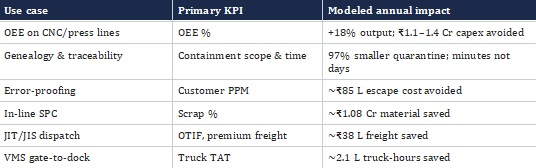
All figures are modeled estimates for a representative plant, not reported client results.
Making Outcomes Attributable
Most MES business cases fall apart in the first CFO review because the "after" numbers cannot be tied to the system. Delpheon deployments are structured so the attribution holds:
- Baseline first. Capture 8–12 weeks of pre-go-live data for each target KPI, using the same collection method you will use afterwards.
- One owner per KPI. Operations owns OEE, Quality owns PPM and scrap, Logistics owns OTIF and TAT. Each signs off on the baseline.
- Control groups where possible. Phase rollout line by line, or compare covered versus uncovered error modes, to separate MES impact from seasonality and mix.
- Finance reconciliation. Scrap, freight and debit savings are reconciled monthly against ledger entries, not dashboards alone.
- Independent sources. OEM-portal OTIF and customer PPM are the customer's numbers, not yours — the most credible evidence you can bring.
Why Delpheon for Automotive
- Enterprise-grade MES at mid-market economics — genealogy, SPC, OEE and interlocks without the licence and integration burden of global tier-one platforms.
- On-premise first — plant data stays on your infrastructure, which matters to OEMs with strict IP and cybersecurity requirements.
- One stack from gate to dispatch — MES and VMS share a data model, so inbound, production and outbound are visible end to end.
- Built for IATF 16949 — traceability, control-plan enforcement and audit-ready records