Automotive has become the single largest driver of manufacturing execution system investment worldwide. But the suppliers who need traceability and real-time control the most — the Tier 1s and Tier 2s beneath the top OEMs — are the ones being priced out of it.
IN BRIEF
- Automotive now accounts for the largest share of global MES spend of any industry vertical, and analysts consistently point to it as the fastest-growing segment — driven by EV complexity, tighter tolerances, and multi-plant coordination.
- The costliest failures on today's automotive shop floor aren't downtime — they're traceability gaps that surface only after a part has shipped, when the cost of not knowing becomes a recall, an audit finding, or a lost OEM contract.
- Enterprise MES platforms were built for the top of the supply chain. Mid-market manufacturers need the same visibility and control, delivered on a deployment timeline and cost structure that matches their scale — not the OEM's.
For a decade, manufacturing execution systems were treated as an enterprise category — something Tier 1 giants and global OEMs budgeted for in multi-year digital transformation programs, alongside SAP rollouts and ERP consolidations. Everyone else ran the floor on a combination of spreadsheets, WhatsApp groups, and institutional memory, and largely got away with it.
That era is ending, and automotive is where it's ending fastest. Industry analysts now rank automotive as the largest end-market for MES investment of any manufacturing vertical, and the segment expected to grow fastest through the rest of the decade — a shift traced directly to the operational complexity that electric vehicle programs, tighter emissions and safety tolerances, and increasingly distributed multi-plant supply chains have introduced. The shop floor got harder to run blind. The market responded.
Automotive Didn't Just Join the MES Market — It Started Running It
The scale of that shift is worth sitting with. Automotive isn't a niche pocket of MES demand tucked inside a broader industrial software category — it's the category's center of gravity. Market researchers now attribute more than a quarter of all global MES spend to automotive manufacturers, ahead of electronics, pharma, and heavy machinery.

Source: aggregated industry market analyses, 2026.
That last figure is the one that matters most for anyone below the top tier of the supply chain. Demand for real-time production visibility has never been higher. But the systems built to deliver it were priced, architected, and sold for the top of the market — leaving the mid-market exactly where it has always been: wanting the capability, unable to justify the price of entry.
Where MES Sits: ISA-95, and What "Real-Time" Actually Requires
The functional scope of MES is defined by the ISA-95 (IEC 62264) automation pyramid, and it's worth being precise about where it sits, because that's exactly where most mid-market plants have a blind spot. Level 0–1 is the physical process and its sensors/actuators; Level 2 is SCADA and PLC control logic; Level 3 is MES — the layer that turns discrete machine events into work orders, genealogy, quality dispositions, and OEE; Level 4 is ERP, handling planning and finance on a scale of days and weeks, not seconds. Most mid-market automotive plants have Level 2 and Level 4 in place — PLCs on the machines, SAP or an equivalent ERP in the office — and nothing coherent at Level 3. That gap is filled manually, by supervisors walking the floor with a clipboard and re-keying end-of-shift numbers into a spreadsheet that becomes the plant's system of record by default.
EXHIBIT 2 — TYPICAL SHOP-FLOOR INTEGRATION STACK FOR AN MES ROLLOUT
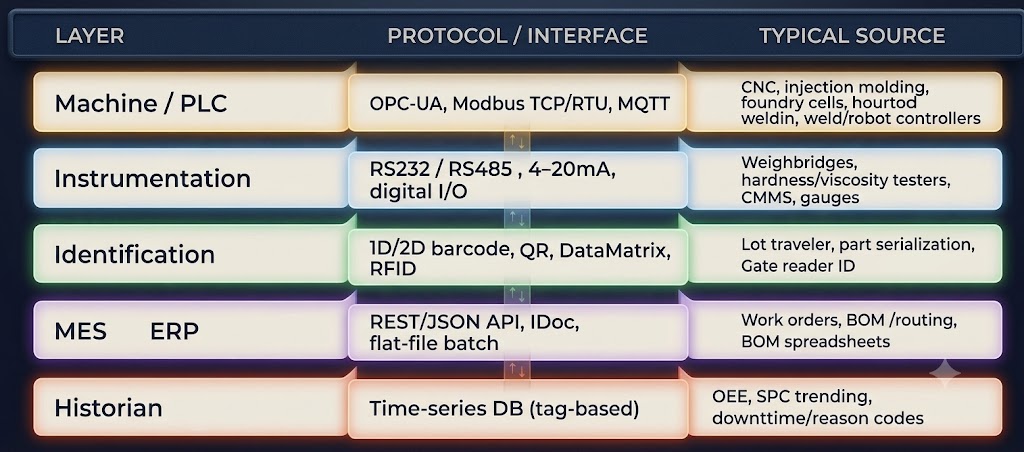
This is the part of an MES deployment that enterprise vendors spend a year on: mapping every PLC's tag structure, negotiating OPC-UA server access on legacy Siemens S7 or Allen-Bradley controllers that were never designed to be polled by an external system, and building the master data model — BOM, routing, work centers, resource calendars — before a single dashboard goes live. A right-sized MES has to do the same integration work; it just has to do it against a scoped set of lines and a lighter data model, rather than standardizing an entire enterprise's tag naming convention on day one.
The Real Cost Isn't Downtime. It's Not Knowing
Ask a plant manager what MES is for, and most will say uptime — catching the stoppage before it cascades. OEE (Overall Equipment Effectiveness) is the standard metric: Availability × Performance × Quality, where Availability is run time over planned production time, Performance is actual output rate over ideal rate, and Quality is good units over total units produced. World-class OEE benchmarks sit around 85%; most unconnected discrete manufacturers run in the 45–65% range simply because downtime and micro-stops are logged inconsistently, if at all, and the Performance term is a guess rather than a tag-derived number.
That's real money. But it's no longer the most expensive failure mode on an automotive shop floor. The most expensive problem is a genealogy question you can't answer fast enough: which heat/lot of raw material went into which batch of castings, which machine, tool, and operator touched a specific part, which SPC (statistical process control) readings and lab test results back a component now sitting in a customer's vehicle. This is forward and backward traceability — given a finished part, walk backward through every process step, machine parameter, and material lot that produced it; given a suspect raw-material lot, walk forward to every finished part it touched. Doing that in a spreadsheet means cross-referencing shift logs, lot travelers, and lab sheets by hand. Doing it in an MES means querying a genealogy table keyed on serialized or lot-level part IDs captured automatically at every process step.
For manufacturers producing safety-critical components — brake systems, castings, structural parts — that query isn't hypothetical. IATF 16949 clause 8.5.2 requires documented traceability appropriate to the product, and clause 10.2.3 requires root-cause analysis and corrective action on nonconformities within defined timelines. An OEM PPAP (Production Part Approval Process) submission or a field failure investigation will ask for exactly this genealogy chain — and the difference between an MES-backed answer and a manual one is minutes versus days, or in a live containment scenario, the difference between quarantining one shift's output and quarantining a month's.
The line that never stops is not the line that wins the audit. The line that can prove, part by part, exactly what happened to it is.
— DELPHEON PERSPECTIVES
This is precisely the gap that paper travelers, disconnected lab systems, and manually logged test results leave open. A rubber compound tested for hardness and viscosity on a benchtop instrument with no digital interface is a data point nobody can retrieve under audit pressure — it exists on a sheet in a binder, not against a lot ID in a queryable system. A casting genealogy tracked across a spreadsheet that's rebuilt every shift is a gap waiting to be found by an OEM auditor rather than closed by the plant itself. SPC compounds this: without automated data capture at the point of measurement, control charts and Cpk calculations are built after the fact from sampled, hand-entered data — which defeats the purpose of SPC as an early-warning system for process drift.
Why the Enterprise MES Model Breaks for the Mid-Market
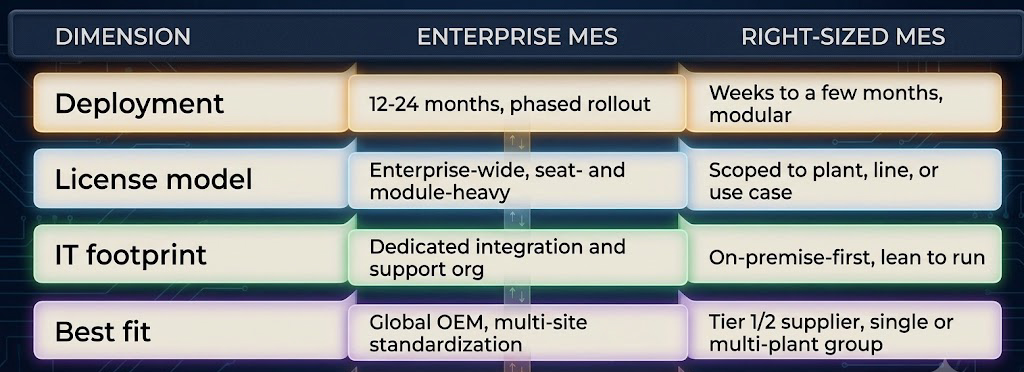
The traditional answer — Siemens Opcenter, Rockwell FactoryTalk, AVEVA — was never wrong so much as it was built for a different customer. These are capable platforms, but they come with enterprise-scale license structures (often per-tag or per-server, stacked with module licenses for quality, scheduling, and genealogy separately), multi-year deployment timelines, and integration projects that assume an IT organization sized to support them — typically a dedicated MES/OT integration team, a change-control process for every PLC touchpoint, and a phased site-by-site rollout plan. For a single-plant or multi-plant mid-market manufacturer, that's not a software purchase — it's a multi-year capital commitment with a payback period longer than most CFOs will approve, and an integration timeline that outlasts the budget cycle that funded it.
The result is a structural gap in the market: manufacturers with genuine, board-level pressure to close traceability and OEE visibility gaps, sitting one price bracket below the systems built to close them.
EXHIBIT 3 — ENTERPRISE MES VS. A RIGHT-SIZED PLATFORM
What a Right-Sized MES Actually Looks Like, Technically
Closing this gap doesn't require reproducing the enterprise platform at a discount — it requires rethinking what a mid-market manufacturer actually needs on day one, versus what can be added as the operation matures, and architecting for that scope from the start.
MES / MES Lite — genealogy and OEE at the line. An edge gateway polls PLCs via OPC-UA or Modbus for machine state, cycle counts, and parameter data, and pairs that with barcode/DataMatrix scans at each process step to bind a part or lot ID to the machine, operator, tool, and timestamp that touched it. That binding is what makes forward/backward genealogy a query instead of an investigation. OEE is computed continuously from the same tag stream rather than reconstructed at shift-end. MES Lite runs the same data model on a narrower scope — a single line or work-center — for plants that want traceability and OEE without committing to full scheduling and dispatch functionality on day one.
LIMS — instrument-connected lab data. Benchtop instruments (hardness testers, viscometers, rheometers, spectrometers) interface over RS232 or direct file export rather than manual transcription, writing results directly against a sample ID that's linked to the production lot under test. That turns SPC from a periodic manual sampling exercise into a live control chart with automatically flagged out-of-control conditions, and makes COA (Certificate of Analysis) generation for a PPAP submission a report, not a reconstruction project.
VMS — the yard and gate layer most MES conversations skip. QR-based gate access, slot scheduling, and weighbridge integration over RS232/RS485 give plant logistics a live view of vehicle turnaround time (TAT) — from gate-in to bay assignment to weighbridge to gate-out — across a facility handling anywhere from a hundred to well over a thousand vehicles a day. For a foundry or high-tonnage plant, this is frequently the fastest-to-deploy, fastest-to-prove-value module: it doesn't touch production PLCs at all, so it can go live in weeks against existing gate and weighbridge hardware.
The common thread across all three is on-premise-first deployment and modular scope — a plant can start with genealogy and traceability on its highest-risk line, prove the value against a real OEE or audit-response metric, and expand module by module from there, rather than signing up for a transformation program before it has evidence the investment will pay back.
WHAT THIS MEANS FOR AUTOMOTIVE MANUFACTURING LEADERS
The MES conversation in automotive is no longer about whether to invest — the market has already answered that question. It's about whether the platform available to you was built for your scale, or merely priced down from someone else's.
For plant and quality leaders managing safety-critical production, the traceability gap is the one worth closing first. It's the failure mode that costs the most, surfaces the latest, and is now the fastest to fix with the right platform underneath it.