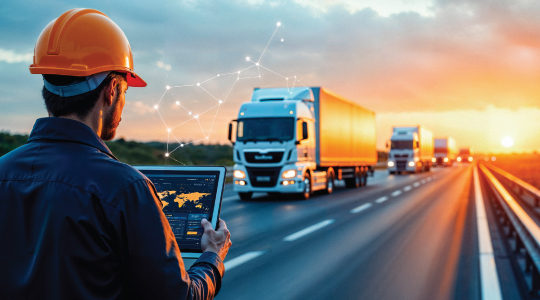
Every manufacturing and logistics operation has spent the last decade digitising everything a truck touches. The order that generates the shipment lives in an ERP. The inventory it carries lives in a WMS. The route it should take lives in a TMS. The customer waiting for it gets a tracking link.
And then the truck itself arrives at a gate — and disappears into a register, a radio call, a guard's memory, and a driver's guess about how long the wait will be.
The truck is the one physical asset in the entire supply chain that every other system depends on, and the one that almost none of them actually manage. Not tracks — manages. There's a difference, and it's the difference this next year of vehicle management platforms is going to close.
What "managing" a vehicle actually means
Ask ten logistics and plant operations leaders what problem they most want solved, anywhere in the world, and the list is remarkably consistent:
"I don't know how long a vehicle will actually take, so I can't plan around it." Not GPS location — predicted arrival, accounting for the loading delay two sites back, the congestion on today's route, and the fact that this particular driver runs 20 minutes behind schedule on Fridays.
"Every handoff between systems and sites loses information." The vehicle that leaves a supplier's dock, crosses a border or a state line, arrives at a cross-dock, and continues to a plant should be one continuous, traceable event. Instead it's four separate transactions in four separate systems, reconciled — if at all — days later.
"I only find problems after they've already cost money." A vehicle running hot on fuel, a driver deviating from a safe route, a reefer unit drifting out of temperature range, a bay standing empty while five trucks queue outside it — all of these are knowable in the moment. Almost none of them are known in the moment.
"Compliance is a monthly scramble instead of a continuous state." Driver hours, vehicle certifications, safety checklists, emissions data, customs and regulatory documentation — assembled under deadline pressure instead of existing, live, whenever an auditor or a customer asks.
"My vehicles are also my most expensive idle asset, and I can't see it." Utilisation, empty running, dwell time, and turnaround — the numbers that would tell an operator whether they actually need the fleet size they're paying for — are guessed at, not measured.
None of these are India-specific problems, or manufacturing-specific problems, or even trucking-specific problems. A hospital linen fleet, a cold-chain distributor in Texas, a mining operation moving ore between sites, and a factory gate in Coimbatore are all describing the same five gaps in different accents.
Where vehicle management is headed — not what it is today
The platforms built to solve this problem over the last decade were built one layer at a time: GPS tracking first, then telematics, then yard management, then dock scheduling — each solving its own slice, each living in its own dashboard. The next generation doesn't add another slice. It removes the seams between them.
Predictive arrival, not tracked location. Machine learning models that combine live position, historical route performance, traffic and weather data, and driver-specific patterns to answer "when will it actually arrive" rather than "where is it right now" — turning every downstream scheduling decision from a guess into a plan.
One continuous vehicle journey, across every site and every mode. A single record that follows a vehicle from origin dispatch, through every gate, every weighbridge, every border, every cross-dock, to final delivery — regardless of which company, country, or system is watching at each stage. The handoff friction that currently loses data at every boundary disappears when the record is the same record everywhere.
Condition monitoring as standard, not premium. Fuel, temperature, tyre pressure, driver behaviour, and vehicle health streaming continuously and triggering action automatically — a reefer trending out of range gets flagged before the load is compromised, not after the delivery is rejected. This is the same shift manufacturing already made with predictive maintenance on machines; vehicles are the next asset class to get it.
Compliance and sustainability reporting generated, not assembled. Emissions per trip, driver hours, safety events, and certification status computed continuously from operational data — because Scope 3 emissions reporting, cross-border compliance, and safety audits are only getting more demanding, everywhere, not just in one market.
Utilisation as a live, benchmarked number. Not a quarterly consultant's report — a continuously updated view of what percentage of fleet and yard capacity is actually productive, benchmarked against your own history and, eventually, against anonymised industry data — so "do we need this many vehicles" becomes an answerable question instead of an annual debate.
An interface that meets the user where they already are. A security guard at a plant gate, a driver on a highway, a dispatcher in a control tower, and a sustainability officer preparing a board report are five completely different users who currently get five completely different — often terrible — tools. The platforms that win the next few years will feel less like enterprise software and more like the consumer apps these same people already use for everything else in their lives.
Why this matters beyond any one geography
The instinct is to treat vehicle and yard management as a regional problem — different documents in India, different carrier networks in Europe, different regulations in North America — and build accordingly. That instinct isn't wrong, but it's incomplete. The regional differences are real and matter enormously in implementation. The underlying problem is not regional at all: a physical, moving, expensive asset that generates data no one is fully using.
A platform built to solve that problem well in one operating environment and extend it — rather than rebuild it — for the next, has an architectural advantage that a purely regional tool or a purely enterprise-global tool both lack. The regional tool never generalises. The enterprise-global tool never gets granular enough to be genuinely useful on the ground, in one specific yard, on one specific Tuesday.
The right shape for this category over the next year is a platform with a global core — the same predictive arrival engine, the same condition-monitoring layer, the same unified vehicle record — flexible enough at the edges to speak whichever documents, protocols, and languages a given site actually runs on. Built once. Adapted everywhere. Not rebuilt for every new market.
What this looks like for the people actually running vehicles
For a plant operations head, it means the four-hour wait becomes a scheduled ninety minutes — and stays that way as the platform learns from every vehicle that comes through.
For a fleet or logistics director, it means fuel, maintenance, and utilisation stop being separate reports reconciled a month late, and become one live number that gets smaller every quarter because it's finally visible.
For a compliance or sustainability officer, it means the emissions report, the safety audit, and the customer ESG questionnaire get answered from data that already exists, instead of assembled under deadline from five different spreadsheets.
For a driver, it means less waiting, clearer instructions, and fewer arguments about what time they actually arrived.
None of this requires the vehicle to get smarter. It requires someone to finally build the layer that was always missing — the one that treats the truck the way the rest of the supply chain has been treated for a decade: as an asset worth managing, not just tracking.
Talk to us about where vehicle management is headed: we're building Delpheon VMS toward exactly this future — starting from real deployments, real gates, and real vehicles, extending outward. If you're thinking about what your vehicle operations should look like eighteen months from now, we'd like to compare notes.