
From planned production to proven readiness: building a connected manufacturing execution layer
How a leading manufacturer of crushing and screening equipment connected ERP planning with shop-floor execution to improve readiness, visibility, utilisation and control.
Executive Summary
Production at the client's machining operations was well planned — but planning alone did not guarantee that a job could actually start. Every work order depended on multiple resources being ready at the right moment: materials, machines, tools, skilled operators, maintenance status, and the SOPs, drawings and approvals that govern execution. When any one of these was missing, the gap surfaced only on the shop floor — as an idle machine, a delayed start, or a scramble of calls and follow-ups.
The client deployed Delpheon MES as a structured execution layer between the ERP and the shop floor. The platform now validates readiness across six dimensions before any work order is released, links live machine data to orders and operators, and converts shop-floor signals into OEE dashboards, downtime analytics and maintenance workflows. The result: production that starts when it is truly ready, losses that are visible and traceable, and a single connected view of execution from operator to management.
At a Glance
Outcomes That Mattered
Validated readiness
Work orders verified across six readiness dimensions before release to production.
Fewer disruptions
Missing resources identified and resolved before they caused shop-floor delays.
Live visibility
Machine status, progress, downtime and OEE measurable in real time, in one view.
Stronger control
Operators, maintenance and supervisors working from one connected MES layer.
The Challenge
Execution readiness was the invisible variable
The plant did not lack planning discipline. ERP schedules were in place, priorities were set, and routing was defined. What the organisation could not see — until the moment of execution — was whether each planned order was genuinely ready to run. Readiness lived in people's heads and in phone calls: a supervisor's experience, a storekeeper's confirmation, a maintenance technician's memory of an open issue.
This informal system worked — until it didn't. Each readiness gap discovered late converted planned capacity into idle time, and each manual confirmation consumed supervisory attention that should have gone to improvement. Performance data compounded the problem: machine status, downtime causes, cycle times and utilisation existed, but in fragments spread across systems, logs and recollection. OEE could be estimated, not managed. By the time losses were understood, the shift that caused them was over.
Four failure patterns recurred across machining operations, summarised in Exhibit 1. Individually each looked like an operational nuisance; together they formed a structural gap between planning and execution.
Exhibit 1
Four recurring failure patterns in the planning-to-execution handoff
Pattern
Readiness gaps
Materials, tools, machine availability, operator allocation and maintenance status were not consistently verified before production started.
Jobs released on schedule, not on readiness
Pattern
Manual coordination
Teams relied on calls, follow-ups and personal experience to confirm whether a job could actually begin.
Supervisory time consumed by confirmation, not improvement
Pattern
Limited live visibility
Machine status, downtime, cycle time and utilisation were not available in one real-time view.
Losses discovered after the fact, not as they occurred
Pattern
Delayed decisions
OEE, downtime and execution data were fragmented across systems and shifts.
Performance estimated rather than managed
What the Client Needed
A structured MES layer that would validate readiness before release, track execution as it happened, and give every level of the organisation — operator, maintenance, supervisor, management — the same real-time picture of machining operations.
The Solution
An execution layer between planning and the shop floor
Delpheon MES was deployed as the connective tissue between ERP planning and shop-floor operations, built on three capabilities that operate as a single flow (Exhibit 2): validate before release, connect during execution, and make performance visible as it happens.
Exhibit 2
Three-layer solution architecture
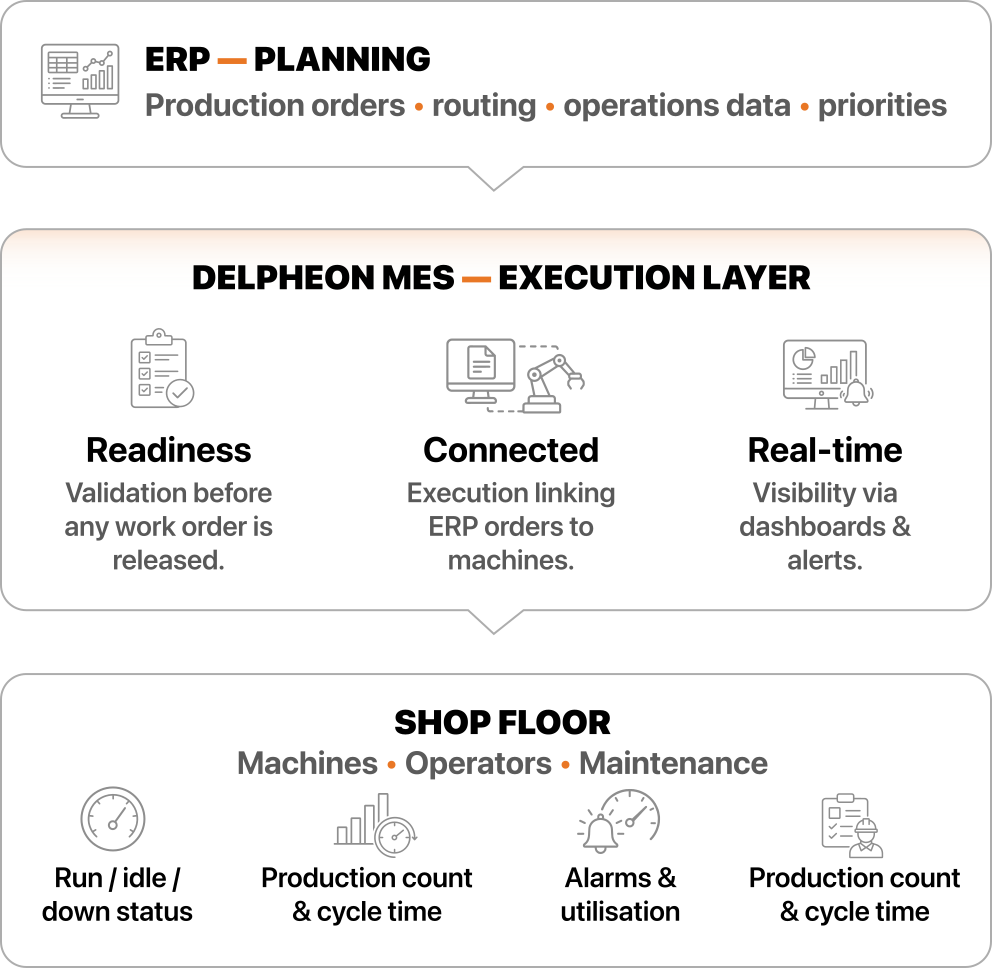
Exhibit 3
The readiness gate — six checks, three states, one rule

Material
Required materials checked; shortages flagged.

Operator
Skilled operator mapped; shift availability.
Ready
Released to machine

Machine
Status checked; PM conflicts flagged.

Maintenance
Open issues checked; spares verified.
Needs Attention
Gap flagged for action

Tooling
Tools assigned; calibration verified.

Checklist
Pre-start checks done; approvals confirmed.
Blocked
Held until resolved
Only executable work orders move forward; incomplete orders remain visible until resolved. The operational effect is immediate: teams resolve gaps before production starts, reducing idle machines, last-minute follow-ups, delayed starts and avoidable OEE losses.
Running the Plant on the Platform
From data capture to digital governance
With readiness gating in place, execution itself became connected. Supervisors assigned work orders to machines and operators inside the platform, while Delpheon MES linked execution status to live machine data — run, idle and down states, production counts, cycle times, alarms and utilisation, always tied to the current work order and operator.
Losses became visible, traceable and actionable. Availability, performance and quality losses were tracked through structured OEE dashboards. Downtime events were captured with reason codes and linked to machines, shifts and work orders. Operators raised maintenance issues directly in the MES, and tickets were tracked from assignment to resolution — every event carrying its full production context.
Above execution sat a layer of digital governance. Operators accessed approved SOPs, work instructions, drawings and validations during execution. Materials, machines, operators, work orders and production activities were digitally linked into end-to-end traceability. Dashboards and alerts gave supervisors and management a live view of OEE, downtime, maintenance, production progress and exceptions — a single source of truth for execution, compliance and performance.

Delpheon MES digitised execution — enabling real-time insights, stronger control and a reliable history of production performance.
Results — From Manual Coordination to Connected Execution Control

Improved readiness
Every work order validated against material, machine, tooling, operator, maintenance and checklist readiness before release — production starts when it can actually run.

Reduced disruptions
Missing resources are identified and escalated before they reach the shop floor, cutting the idle time, delayed starts and firefighting that readiness gaps used to cause.

Live visibility
Machine status, production progress, downtime and OEE became measurable in real time — losses are managed as they occur, not reconstructed after the shift.

Stronger control
Operators, maintenance teams, supervisors and management now work from one connected MES layer, with shared data, shared context and clear accountability.
The Foundation Ahead
Beyond the immediate operational gains, the engagement established a scalable foundation for connected, controlled and data-driven manufacturing execution. With readiness, execution and performance on one platform, the client can extend the same discipline to additional lines, plants and use cases — from deeper analytics to tighter ERP-to-shop-floor closed loops.
Delpheon MES
The execution layer for discrete manufacturing: work-order readiness, connected execution and real-time performance visibility between your ERP and your shop floor.
Ready to see readiness,
not just planning?
Talk to us about deploying Delpheon MES as the execution layer between your ERP and your shop floor.